Log noise hides real attacks
SQL injection strings, XSS payloads, bad bots, and credential attacks are buried inside normal API traffic.
IntrusionDetector.ai helps you detect intrusions in real time using AI, including attacks traditional IDS tools can miss. Your team can miss real attacks when dangerous requests are buried inside noisy server logs
Suspicious login abuse
Multiple failed sign-ins, unusual user agent, and risky IP behavior. Alert created.The problem
Attackers do not wait for your team to manually read logs. A useful AI intrusion detector must separate real risk from junk fast.
SQL injection strings, XSS payloads, bad bots, and credential attacks are buried inside normal API traffic.
If a human has to inspect every suspicious request, your intrusion detector is already behind.
"Suspicious activity detected" is not enough without severity, evidence, category, and context.
The guide
We help builders, SaaS teams, and security-conscious product teams detect suspicious API events without turning their application into a brittle blocking maze.
Likely login abuse targeting an authentication endpoint. The request pattern shows repeated failures, suspicious metadata, and behavior that should be investigated.
Why this exists
Modern web and API attacks often look like normal requests. A simple GET /api/orders/9281 is harmless until the application context says User A tried to access User B's order, was denied, and kept probing object IDs.
That is the blind spot this product attacks: suspicious behavior inside your app, not just scary strings in traffic.
They may see a route, IP, method, and payload. Useful, but not enough for SaaS abuse.
User, tenant, object ownership, permissions, sessions, tokens, response status, route sensitivity, and behavior over time.
Runtime telemetry
The lightweight SDK or direct API ingestion captures security-relevant HTTP and API activity without forcing your application to wait on the detector.
HTTP method, path, query parameters, selected headers, source IP, user agent, response status, response time, service, environment, and project.
User, tenant, object, permission, ownership, token, session, origin, and workflow metadata when your app provides it.
Passwords, authorization headers, cookies, tokens, credit cards, and secrets should be redacted or excluded before storage.
Django middleware, Flask integration, manual Python client, direct HTTP ingestion, and custom integrations for non-Python apps.
Threat coverage
The detector combines local security rules, behavioral detection, application metadata, historical activity, risk scoring, optional AI analysis, alert grouping, and human-readable recommendations.
SQL injection, command injection, template injection, code evaluation payloads, reflected XSS, script tags, JavaScript URI payloads, SVG and iframe indicators.
Path traversal, .env, .git, backup files, database dumps, phpinfo, WordPress, Joomla, Drupal, Magento, PrestaShop, and TYPO3 probing.
Swagger, OpenAPI, GraphQL, private routes, internal APIs, localhost targeting, internal IPs, cloud metadata endpoints, and non-HTTP protocol abuse indicators.
Login probing, repeated failures, credential stuffing indicators, password reset probing, token endpoint abuse, replay indicators, and unusual session reuse.
BOLA, IDOR, cross-tenant access attempts, object ownership mismatch, permission bypass attempts, object enumeration, and post-auth workflow abuse.
SQLMap, Nikto, Nmap, Masscan, WPScan, Gobuster, FFUF, Burp indicators, repeated 404/401/403 probing, route fan-out, and low-and-slow attacks.
Who it is for
Get clear alerts with what happened, why it matters, risk score, indicators, route, source IP, and the next investigation step.
Monitor tenant-aware abuse, object access abuse, suspicious authenticated behavior, and risky workflows across dashboards and APIs.
Add runtime security visibility without deploying a heavy enterprise API security platform or drowning in raw logs.
Install the SDK across client projects and give each client their own dashboard, API key, events, alerts, and visibility.
Three-step setup
Install the SDK, connect your project, and watch suspicious web and API activity turn into alerts your team can act on fast.
Add the IntrusionDetector.ai SDK to your web app so security-relevant requests and authentication events can be monitored.
Create a project, add your API key, and send events securely from your backend, middleware, edge function, or gateway.
See events, risk scores, and alerts in one place so your team can act fast against today’s smart attackers.
Use cases
Use it where API abuse can cost you data, trust, uptime, or money.
Detect suspicious SQL-like payloads, malformed queries, and attack strings in request fields.
Spot brute force patterns, repeated failures, strange user agents, and risky authentication traffic.
Identify bots probing sensitive paths, admin routes, environment files, and unsupported methods.
Flag script injection attempts and unsafe payload patterns before they become customer-facing damage.
Product experience
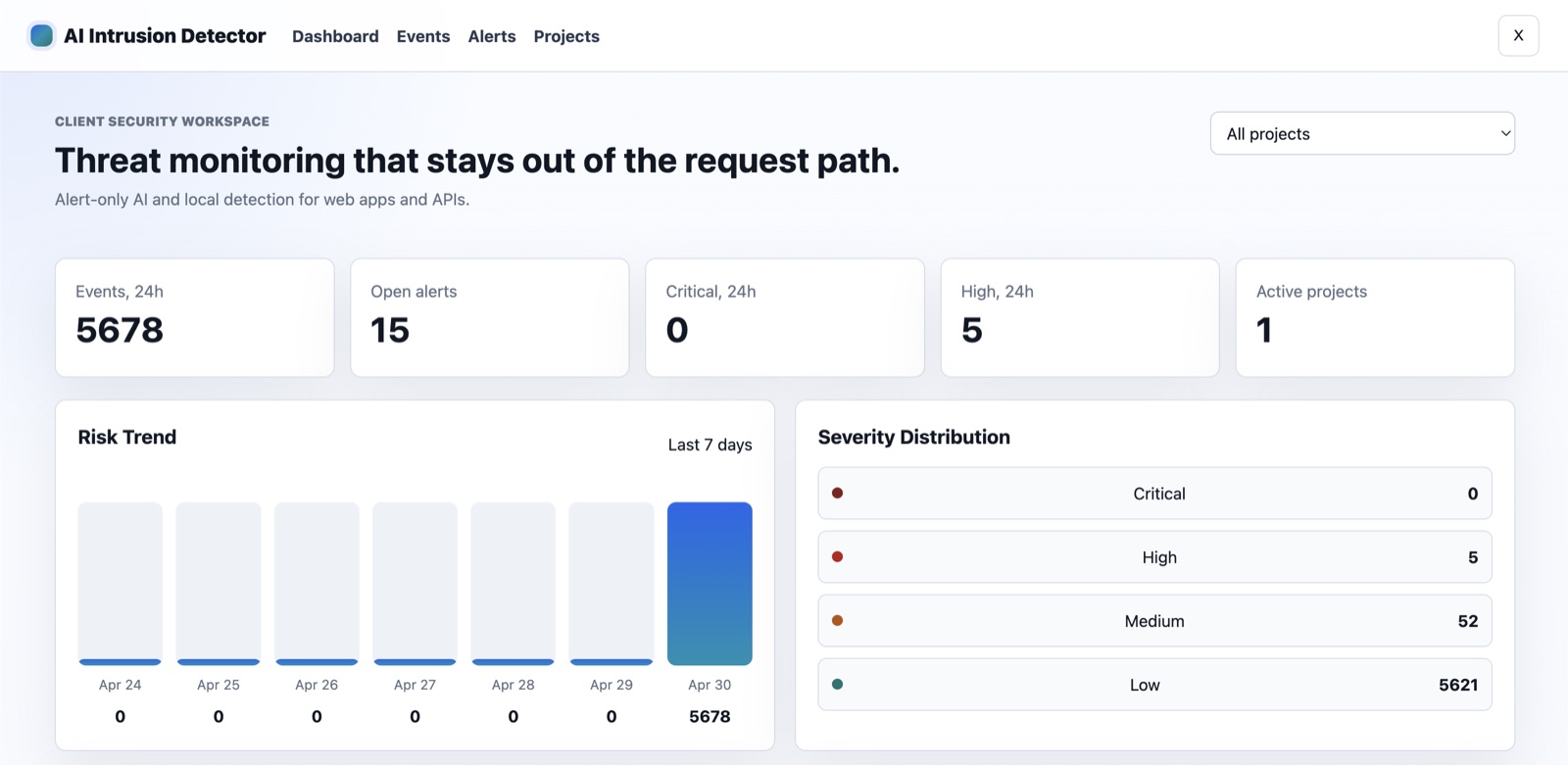
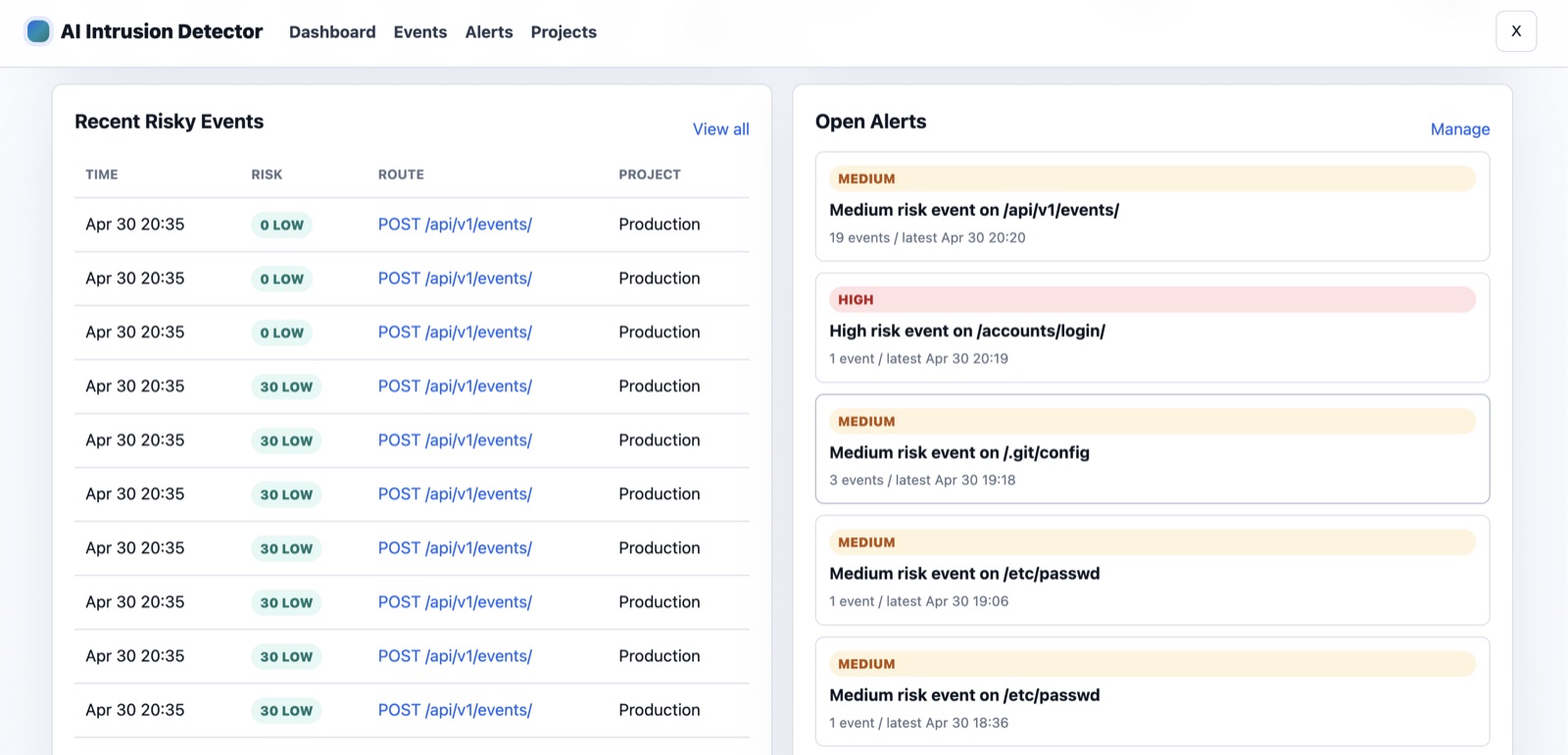
The app is organized around the moments that matter: monitoring, triage, grouped alerts, investigation detail, and redacted evidence.
The dashboard gives teams a fast read on event volume, open alerts, severity distribution, and active projects without forcing every request through a blocking path.
Operators compare recent risky events against deduplicated alerts, then move from noisy telemetry to the items that deserve review.
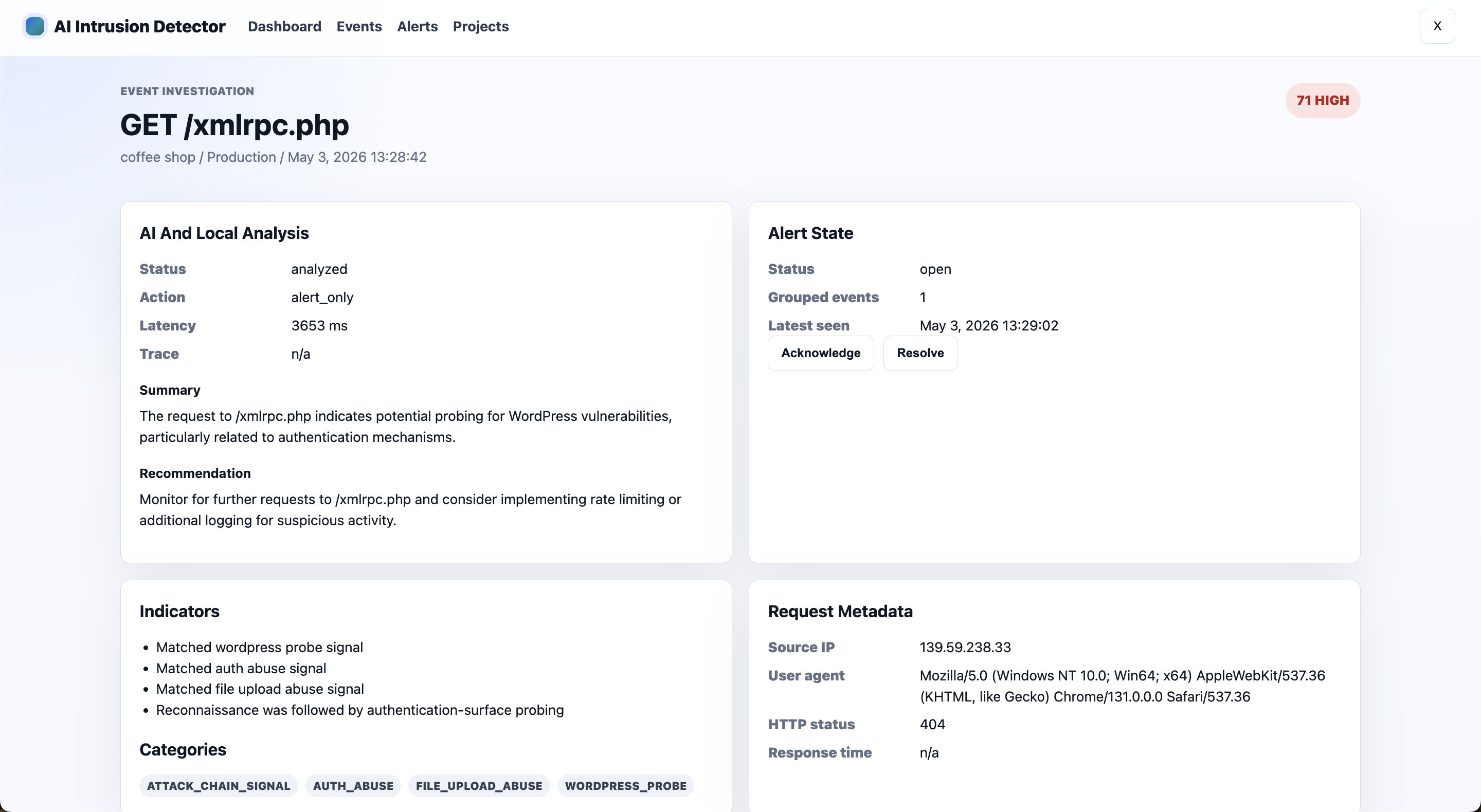
Every event detail page shows the AI model, latency, alert-only action, grouped status, summary, and recommendation.
Interactive demo
Use mock mode for a safe preview, or paste a test project API key to send a real event and see how AI turns suspicious activity into an alert.
Click "Mock analysis" or send a real event.
Works through a direct event endpoint, so you can integrate from almost any stack.
The goal is not more dashboards. The goal is fewer blind spots.
The first 20 users get free access while the product grows.
FAQ
Straight answers for teams choosing what to monitor next.
An AI intrusion detector analyzes event data, request metadata, payload patterns, and behavior signals to detect likely attacks. Instead of only storing logs, it scores risk and explains why an event looks suspicious.
A traditional intrusion detector often relies heavily on static signatures and generic rules. IntrusionDetector.ai focuses on API events, AI intrusion detection, risk scoring, attack classification, and human-readable summaries.
It is an AI intrusion detection system for visibility and alerting. It helps you understand suspicious API activity before you decide what to block, rate-limit, or investigate.
Yes. Use Django middleware, Flask integration, a manual Python client, direct HTTP ingestion, or a custom integration for non-Python apps. The core workflow is API-first: send a JSON event to /api/v1/events/ with your project key in the X-AID-Key header.
No. IntrusionDetector.ai is alert-only by design. That is a safer adoption path because teams can observe, investigate, tune thresholds, and then decide what to block or rate-limit in their own stack.
Do not send passwords, authorization headers, cookies, raw tokens, credit cards, secrets, or private data that your team does not need for security investigation. Redact or exclude those fields before storage.
That phrase is usually a misspelling of "AI intrusion detection system." IntrusionDetector.ai is built for that exact use case: detecting suspicious API events with AI-assisted risk analysis.
Yes. IntrusionDetector.ai is free for the first 20 users during the early access launch. After that, pricing can evolve based on usage, event volume, and team needs.
Early access
Use an AI intrusion detector that gives you risk, context, and a reason to act.